| .......................................................................................................................................................................................... |
| The
Nehru Trophy Boat Race |
| .......................................................................................................................................................................................... |
|
The Nehru Trophy Boat Race, the most colorful water sport
in Kerala, is conducted at PUNNAMADA LAKE in Alappuzha on
the second Saturday of August every year and this prestigious cultural
event of Kerala has been attracting people from all over the world.
Nehru Trophy Boat Race is a festival for the people of Alappuzha.
Though it is a festival,what stands apart is the sportive spirit
among the participants of the race.
Even though innumerable number of boat races are held in Kuttanad
and several parts of Alappuza every year, Nehru Trophy Boat race
is a class of it's own and has gained a popularity that no other
boat race in Kerala can boast of.
The trophy named 'NEHRU TROPHY' is
awarded to the winner of the boat race.The trophy is a replica of
a snake-boat in silver, placed on wooden abacus on which the following
words of Punditji are inscribed above his signature.
"To the winner
of the boat-race which is a unique feature of community life in
Travancore-Cochin".
This
aquatic festival fosters a sense of unity,fraternity and sportsman
spirit and attracts the largest number foreign tourists for any
boat race of it's kind.
A
Flashback:
In
the year 1952, Pundit Jawaharlal Nehru visited the erstwhile Travancore
- Cochin. On his way to Alappuzha from Kottayam the people of Alappuzha,
escorted by the huge snake-boats, gave him a roaring reception.
Having gone through the tremendous excitement of sailing in a snake-boat
popularly known as Chundan, Jawaharlal Nehru donated a rolling trophy
to be awarded to the winner.
This trophy was later christened, 'Nehru Trophy'. The
first race was an ‘impromptu’ one held in honour of Panditji. On
that occasion Ten Snake boats were present and Nedubhagam Chundan
won the race.
In 1953 the boat race was not conducted. In order to commemorate
the occasion every year "Nehru Trophy Boat Race" is conducted
in all splendor by the Nehru Trophy Boat Race Society.
Many
different kinds of country-boats like Iruttukuthy, Veppu and Churulan
also participate in the race; women and students also compete in
the events over a distance of 4850 ft. The beautiful scenery of
the race area together with the exciting snake-boat race, will ever
remain a cherished memory for the onlookers.
The
presence of high dignitaries and distinguished personalities has
enhanced the fame of the NTBR over the years. This prestigious water
carnival celebrated its 50th anniversary in 2002.In fact Nehru Trophy
Boat Race has enabled Alappuzha to achieve prominance in the World
Tourism Map. |
| |
| THE
STORY BEHIND BOATRACES |
The
Rajas of Yore
The story of these battling boats goes back 400 years in history
when the rajas of the erstwhile principalities of Chempakasseri
(Ambalappuzha), Kayamkulam ,Thekkumkoor (Changanacherry) and Vadakkumkoor
(Kottayam) in the old Travancore area, which were part of the present
Alappuzha district and Kottayam district, frequently crossed swords
on the backwaters of Kuttanad. The Chempakasserry troops suffered
heavy casualties at the hands of the superior navy their rivals
commanded. It soon dawned on the Chempakasserry Raja that the real
defect was with his war boats, which were sluggish and cumbersome.
He called all
the boat architects in the land to his court and told them of his
desire to have better and faster boats for the troops. After days
of hard labor, a man who was reputed to be the best boat architect
in Chempakasserry, Koduppunna Venkitanarayanan Asari, came up with
a specimen which satisfied the raja’s requirements. It had
speed, manoeuverability and capacity to carry 100 able-bodied warriors
on board and its eel-like construction was most ideal for launching
an ambush since it could be easily kept concealed behind the overhanging
bushes on the river banks. The Asari was generously rewarded and
in the subsequent battles, the Chempakasseri Raja emerged victorious.
The
Deceit
The story goes
on to tell how the defeated Kayamkulam Raja sent a spy to Chempakasserri
to learn the secret of the new war boat. The spy, a handsome youth,
succeeded in seducing Asari’s daughter. The girl’s mother
was overjoyed by the prospect of getting him as her daughter’s
bridegroom and persuaded her husband to teach him the construction
of the boat.
Needless to
say, the deceitful youth disappeared the moment he thought that
he had learnt the secret. Asari was imprisoned by Chempakasserri
Raja for treason. But he was released and showered with many honors
when the snake boats built by the Kayamkulam Raja proved to be no
match for the war boats of Chempakasserry in the next battle. The
subtleties of the snake boat’s design are hard to pickup and
even today it requires years of apprenticeship under a master boat
architect before one could independently undertake the construction
of this ancient boat.
When a village
decides to have a new snake boat, a committee is formed to raise
the Rs.6 lakhs it requires now to build the boat. The boat architect
is summoned and the search for the “anjili” tree of
the required size often takes the villagers to the high ranges of
Kerala. As the snake boat takes shape out of the huge trunk, the
‘asari’ relies mainly on his instinctive estimates.
Of late, the
boat builders’ prime concern is to make the snake boat as
long as possible so as to seat more and more rowers for speed. The
Nedumbhagom snake boat recently entered the Guinness Book of Records
as the longest rowing boat in the world. But its 135 feet length
has since been overtaken by Vellankulangara snake boat, which is
140 feet long.
|
| .......................................................................................................................................................................................... |
| HISTORY
ABOUT BOAT RACES |
| .......................................................................................................................................................................................... |
| The
boat race is a sport that signifies excellent team spirit, integration
and amity of the people of this backwater country and is a great
occasion for excitement. It vividly portrays the life of a vibrant
people. Boat
races are celebrated as the festival of backwaters with all pomp
and splendor. In fact these water carnivals are inseparable from
the life of a community, which is dependent on boats for commuting
and communication in a water logged area. Perhaps snake boat race
would be the only sporting event in the world in which hundreds
of people participate in a competition. It stands as a symbol of
communal harmony; but at the same time it is also a competition
of muscle power.
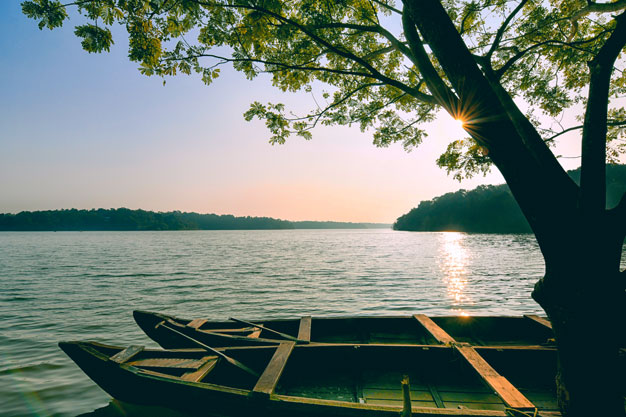
Boat races are magnificent fiestas that bring alive the tranquil
backwaters and these races are held in connection with Onam, the
harvest festival in August/September. Scores of long snake boats
and other smaller crafts participate in these events. The largest
team sport in the world, the snake boat races are preceded by colorful
water parades. Usually four helmsman, 25 singers and 100-125 oarsmen
who row in unison to the fast rhythm of the Vanchipattu man a snake
boat. Thousands of people crowd the water's edge to cheer the huge
black crafts as they slice through the waters to a spectacular finish.
In
the lakes and canals of Alappuzha different kinds of boats can be
identified ranging from small country crafts for single person to
boats carrying hundreds of people. In the good golden days these
boats were the only major means of cargo and passenger transportation
in this backwater country. Country canoes, rice boats (Kettuvallom),
house boats, race boats etc. are the other different kinds of boats
to be seen around.
Boat
race Calendar:
The Champakkulam Moolam boat race (July) heralds the onset of the
boat race season. The other boat races are Aranmula Uthruttathi
Vallam kali (September), Payippad Jalotsavam (September), Rajiv
Gandhi boat race, Pulincuunnu (Aug/Sep), Neerettupuram boat race
(Sept), Karuvatta boat race, Kumarakom boat race, Kavanattinkara
boat race, Kottappuram boat race, Kodungallor boat race, Arppookkara
Vanitha Jalamela, Kottayam Mahatma boat race, Mannar boat race,
Thazhathangadi boat race, Kumaranasan Smaraka Jaloltsavam, Pallana
and finally the Indira Gandhi boat race at Kochi. |
| .......................................................................................................................................................................................... |
| Boat
Categories |
| |
| 1.
CHUNDAN VALLAM (SNAKE BOAT) |
| .......................................................................................................................................................................................... |
| The
boats of Kerala are categorised and named as per their shapes, sizes
and purposes. The Chundaanvallam is so called because of its pointed
prow. The term snake boat indicates the shape of the stern which
resembles the raised hood of a snake. The front end of this type
of boat will be tapering in shape and the rear end will be highly
elevated from the water level. It has a length of about 60-65 meters
and a capacity to carry over a hundred to hundred and ten people
during a race. The stern is majestically caparisoned and decorated
with a flag and brass ornaments. Silken parasols are arrayed along
the entire length of the boat. There will be almost 95 oarsman,
5 Amarakkar (Controllers) and 10 'Nilakkar' (persons supposed to
enhance the vigour and enthusiasm of the participating oarsman).
It has the semblance of a snake, while advancing in a competition
and hence became popular as snake boats. These boats were the traditional
battle vessels of Kerala. |
| .......................................................................................................................................................................................... |
| 2. CHURULAN
VALLAM (RACE BOAT) |
|
| .......................................................................................................................................................................................... |
| The
Race Boats "churulan vallams" are boats having a capacity
to acommodate about 45 persons and are designed as passenger boats.The
ends of these types of boats are shaped as a Circular ring (Churul
in Malayalam). |
| .......................................................................................................................................................................................... |
| 3.
VAIPU VALLAM |
| .......................................................................................................................................................................................... |
| 'Vaipu'
vallams are boats having a passenger capacity of about 40-45 persons.
One end of the boat is always higher than the other end. These boats
were originally meant to prepare food for the other vessels during
war . |
| .......................................................................................................................................................................................... |
| 4.
IRUTTUKUTHY/ODI |
| .......................................................................................................................................................................................... |
| Iruttukuthy
or Odi type of boats are designed for transportation during the night.
The shape of the boat is suitable for speedy journey. The width of
the boat is so designed as to avoid friction with water while moving.
In olden days these boats were supposed to be used for piracy works. |
| .......................................................................................................................................................................................... |
| VANCHIPATTU
(SONG OF THE BOATMAN) |
| .......................................................................................................................................................................................... |
| These
highly rhythmic songs were created to keep up the spirit of the
boatman. These songs were so framed and sung as to keep pace with
the movement of the oars and to keep alive their devotional, mythological
and rustic life styles. Every snake boat has about twenty-five singers
with their traditional percussion instruments.
|
|
Click
Here for Theme Song |
| .......................................................................................................................................................................................... |
| Technical
Specifications |
| Track
length – 1400 M.
Chundan -
Amaram - 5 Persons
Nilakkar - 5 Persons
Total no. of team members- 111
Tracks –
4 tracks of 10 M. wide from East
|
| |
| Communal
amity |
| The
preparations for this big event begins several weeks in advance:the
snake boats have to be smeared with sardine oil for a smooth passage
through the water, the best oarsmen have to be selected and finally
the practice session begins under the supervision of the senior most
oarsmen. Around 150 oarsmen, who would represent the village, take
the vow to observe strict abstinence and celibacy till the oars are
handed over to each of them. Feeding the oarsmen during the practice
sessions and on the day of the festival is done by the villagers themselves
or by the rich and wealthy who foot in the entire expenses incurred.
Even at the height of the caste system, the peculiar
feature of these regattas was that the caste Hindus, Scheduled Castes,
Christians and Muslims all sat in the same row for the feast symbolising
the communal amity in Kuttanad. In fact, the Church has a traditional
role in the celebrations at Champakkulam even though the water festival
there is associated with a temple legend.
|